
Materials, Sizing & Care.
Materials.
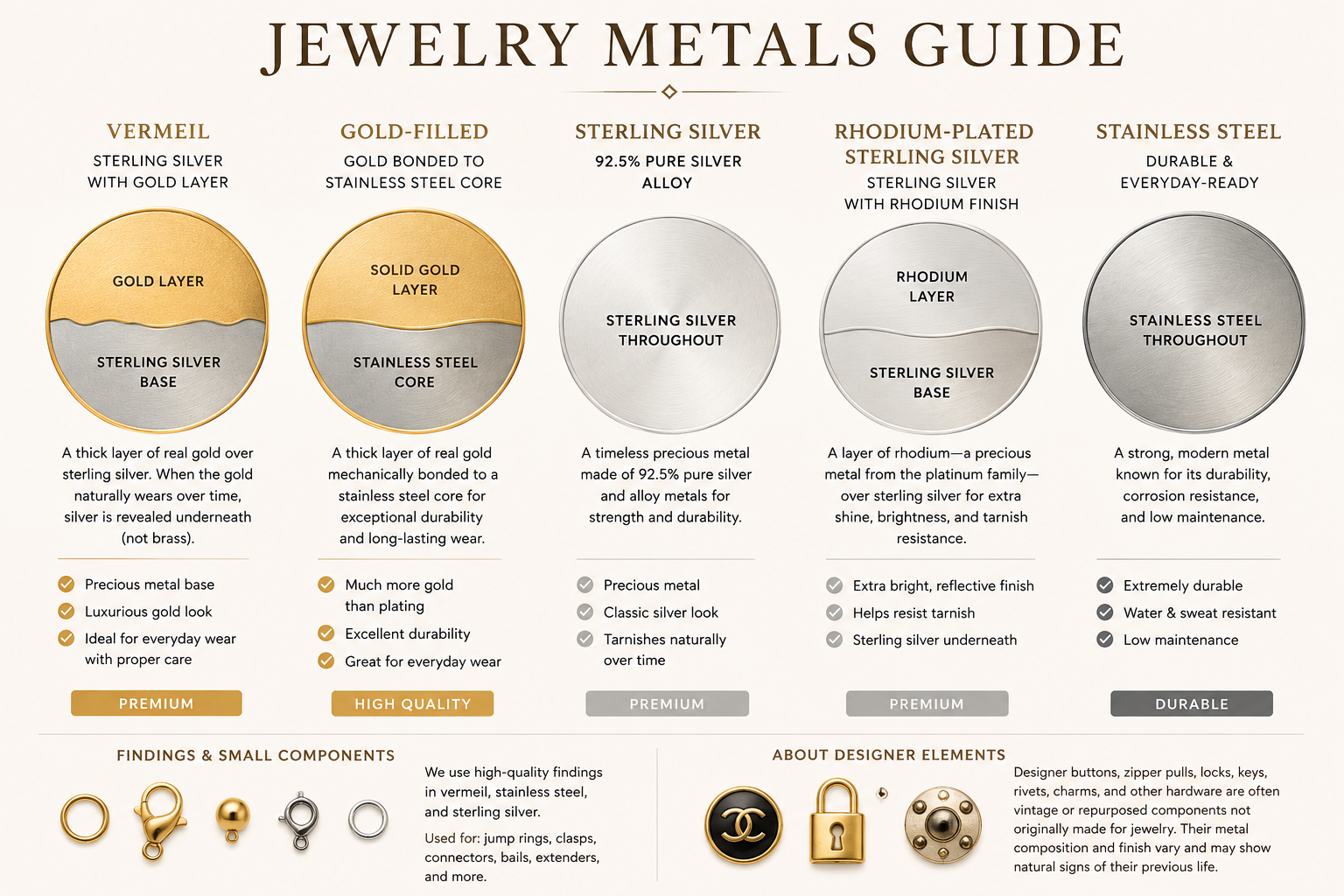
Butones Jewelry is made using thoughtfully selected materials chosen for their quality, durability, wearability, and ability to complement repurposed designer elements.
Because every design is different, materials may vary from piece to piece. The most commonly used materials are gold vermeil, gold-filled components, sterling silver, rhodium-plated sterling silver, and stainless steel.
Small jewelry findings—such as jump rings, clasps, connectors, and other components are typically vermeil or stainless steel, with sterling silver used in select designs.
Specific materials used in an individual piece are listed in its product description whenever applicable.
GOLD VERMEIL
Gold vermeil offers the look and warmth of real gold while using sterling silver as its base metal.
To qualify as vermeil in the U.S., the piece must have a sterling-silver base covered with a substantial layer of gold. This makes vermeil a higher-quality option than ordinary gold plating over inexpensive base metals.
One reason I use vermeil frequently is what happens as it naturally ages: because the metal underneath is sterling silver rather than brass, gradual wear of the gold finish may eventually reveal silver beneath rather than a brass-colored base.
With proper care, vermeil can remain beautiful for a long time, although the gold surface will naturally wear over time depending on friction, body chemistry, moisture, products, and frequency of use.
Material level: Precious-metal base with a real gold finish; one of the more elevated materials commonly used in Butones Jewelry.
GOLD-FILLED
Gold-filled jewelry contains a substantial layer of real gold that is mechanically bonded to a core metal, rather than simply having a very thin layer of gold deposited onto the surface.
This bonded construction makes quality gold-filled components significantly more durable than conventional gold plating and well suited to jewelry intended for regular wear.
Butones uses gold-filled components sourced according to supplier specifications, including pieces made with stainless-steel cores rather than brass where specified by the supplier.
The stainless-steel base provides strength and durability, while the bonded gold exterior gives the appearance and character of gold.
Gold-filled surfaces can still change with prolonged wear, friction, chemicals, chlorine, saltwater, and other environmental exposure, but they generally offer excellent longevity compared with standard gold-plated jewelry.
Material level: High-quality, durable gold-finished jewelry material designed for frequent wear.
Note: “Gold-filled” is a regulated jewelry term and construction can vary by supplier. Butones relies on the material specifications supplied by our trusted jewelry-component sources.
STERLING SILVER
Sterling silver is a precious-metal alloy containing 92.5% silver, with the remaining percentage consisting of other metals added for strength.
Pure silver is naturally very soft, so sterling silver provides a better balance of beauty, durability, and everyday wearability.
Sterling silver can naturally tarnish or darken over time as it reacts with air, moisture, body chemistry, and environmental conditions. This is normal and does not mean the material is damaged or poor quality.
Unlike a plated finish, solid sterling silver can generally be cleaned and polished repeatedly throughout its life.
Material level: Precious metal and one of the most enduring materials used in Butones Jewelry.
RHODIUM-PLATED STERLING SILVER
Some Butones silver pieces use sterling silver finished with a layer of rhodium.
Rhodium is a bright, naturally white precious metal from the platinum family. Applying rhodium over sterling silver creates a crisp, highly reflective finish while also helping protect the silver underneath from tarnishing and everyday surface exposure.
Rhodium plating is still a surface finish, however, and may gradually wear in areas that experience repeated friction. Once the rhodium layer wears, the sterling silver underneath remains.
Because the base itself is sterling silver, the piece retains the value and character of a precious-metal foundation even as the surface finish naturally evolves.
Material level: Precious-metal sterling silver with an additional premium protective finish.
STAINLESS STEEL
Stainless steel is used selectively for findings and other components where strength, stability, and durability are particularly important.
It is resistant to corrosion, generally requires very little maintenance, and holds its shape well—making it especially useful for functional components such as clasps, connectors, and certain chain designs.
Unlike sterling silver, stainless steel is not considered a precious metal, but its exceptional durability makes it a practical and reliable jewelry material.
Material level: Highly durable, functional jewelry-grade material valued primarily for strength and longevity.
FINDINGS & SMALL COMPONENTS
The smallest parts of a piece are often some of the most important.
Jump rings, clasps, connectors, bails, extenders, and similar findings used in Butones Jewelry are typically selected from:
Gold vermeil • Stainless steel • Sterling silver
The material chosen depends on the design, strength required, color, construction, and the designer element being incorporated.
I intentionally avoid relying on inexpensive brass findings as the standard construction material for Butones pieces.
HOW THE MATERIALS COMPARE
A simple way to understand the materials used throughout Butones:
Precious-metal foundation
Sterling Silver • Rhodium-Plated Sterling Silver • Gold Vermeil
These contain sterling silver as the primary metal underneath the finish, or are sterling silver themselves.
Durable gold-finished material
Gold-Filled Components
Chosen when lasting gold appearance and everyday durability are especially important.
Durable functional material
Stainless Steel
Chosen for strength, stability, and resistance to corrosion, particularly in findings and structural components.
There isn't necessarily one material that is “best” for every design. Each offers different advantages, and I select materials based on how the piece is constructed, how it will be worn, and what best supports the design.
A NOTE ABOUT DESIGNER ELEMENTS
The repurposed designer elements at the center of many Butones pieces are different from the jewelry materials described above.
Buttons, zipper pulls, locks, keys, rivets, charms, and other designer hardware were often originally created for garments, handbags, or accessories rather than jewelry. Their exact metal composition and original finishes vary by designer, age, and intended use.
Some elements are unused spare components; others are vintage or repurposed and may carry natural signs of their previous life, such as patina, fine scratches, surface wear, or variation in finish.
That history is part of what makes each Butones piece unique.
Read more about our DESIGNER MATERIALS.
MATERIALS & NATURAL WEAR
No jewelry material stays completely unchanged forever.
Gold finishes may gradually soften or fade. Sterling silver may tarnish. Rhodium plating can wear. Vintage hardware may develop additional patina.
How quickly this happens depends greatly on body chemistry, climate, moisture, friction, cosmetics, frequency of wear, and how the jewelry is stored and cared for.
These changes are a normal part of wearing jewelry and do not necessarily indicate a defect.
For information on protecting each material, please refer to our Jewelry Care Guide below.
Sizing.
NECKLACE
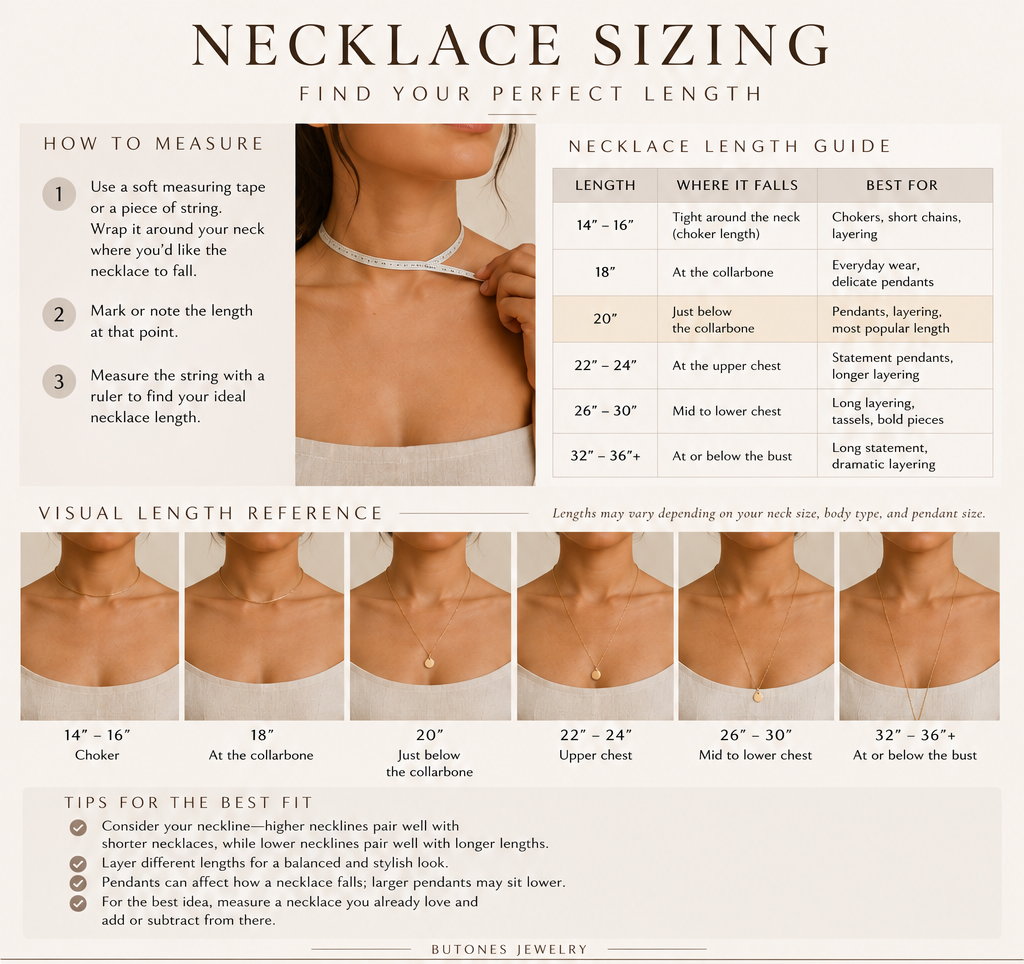
Butones Jewelry offers a range of necklace lengths to suit different styles, necklines, and layering preferences. Our most commonly used women’s lengths are 18" and 20", but the way a necklace sits can vary depending on your neck circumference, body proportions, pendant size, and chain style.
As a general guide:
14"–16" — sits close to the neck; ideal for chokers or short layering pieces
18" — falls around the collarbone; a classic everyday length
20" — sits slightly below the collarbone; great for pendants and layering
22"–24" — falls toward the upper chest for a longer, more relaxed look
30"+ — creates a long statement silhouette and may fall at or below the bust
For the best fit, we recommend measuring one of your favorite necklaces or using a soft measuring tape around your neck to see where your preferred length will fall.
Please note: necklace placement varies from person to person, so the measurements above are intended as a general guide rather than an exact fit.
BRACELET
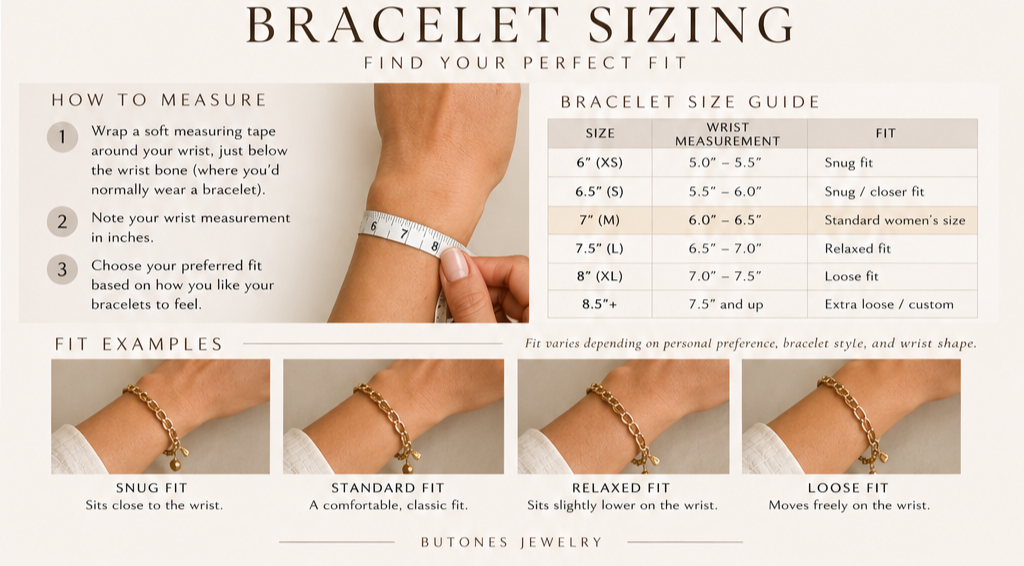
Butones Jewelry offers a range of bracelet lengths to suit different wrist sizes, bracelet styles, and fit preferences. Our most commonly used women’s size is 7", but the way a bracelet fits can vary depending on your wrist circumference, chain thickness, design, and how snug or relaxed you prefer to wear it.
As a general guide:
6"–6.5" — best for smaller wrists or a closer, more fitted look
7" — our most common women’s size; a comfortable everyday fit
7.5" — offers a slightly more relaxed fit with a little extra movement
8" — ideal for a looser fit or larger wrist
8.5"+ — provides an extra-loose fit and may work well for chunkier or statement styles
For the best fit, we recommend measuring a bracelet you already love or wrapping a soft measuring tape around your wrist where you normally wear your bracelet. If you prefer a relaxed fit, allow a little additional room beyond your exact wrist measurement.
Many Butones pieces can be adjusted or customized depending on the design. If you need a different length, an extender, or another adjustment, please contact us or explore our Jewelry Adjustment service.
Jewelry Care.
Butones Jewelry is handcrafted using a combination of quality jewelry materials, repurposed designer elements, and vintage components. Depending on the piece, materials may include gold-filled, vermeil, sterling silver, rhodium-plated sterling silver, and vintage or repurposed designer hardware.
Because every material ages differently—and many Butones elements have already lived a life before becoming jewelry—a little care goes a long way in preserving your pieces.
To help your Butones Jewelry stay beautiful for as long as possible:
Remove jewelry before showering, swimming, exercising, sleeping, or entering pools, hot tubs, oceans, or saunas.
Avoid prolonged exposure to water, sweat, humidity, saltwater, and chlorine.
Apply perfume, hairspray, lotion, sunscreen, oils, makeup, and other beauty products before putting on your jewelry and allow them to dry first.
Avoid direct contact with household cleaners, alcohol, sanitizers, bleach, and other chemicals.
After wearing, gently wipe your jewelry with a clean, soft, dry cloth to remove oils, moisture, and residue.
Avoid pulling, twisting, bending, or placing unnecessary pressure on chains, clasps, connectors, pendants, and repurposed elements.
Put jewelry on last when getting ready and take it off first when changing or undressing.
GOLD-FILLED
Gold-filled jewelry contains a substantial layer of real gold mechanically bonded to a base metal. It is considerably more durable than standard gold plating and, with proper care, can maintain its appearance for many years.
Gold-filled jewelry can tolerate normal everyday wear, but repeated exposure to chlorine, saltwater, sweat, cosmetics, perfumes, and harsh chemicals can eventually dull or affect the surface.
To clean gold-filled jewelry, gently wipe it with a soft cloth. When deeper cleaning is necessary, use lukewarm water with a small amount of mild soap, rinse carefully, and dry the piece completely with a soft cloth before storing.
Avoid abrasive polishing compounds, rough cloths, brushes, or chemical jewelry cleaners unless they are specifically intended for gold-filled jewelry.
GOLD VERMEIL
Gold vermeil consists of a layer of gold applied over sterling silver. It offers the beauty of gold with sterling silver underneath, but the gold surface can gradually wear with friction and repeated exposure to moisture or chemicals.
Vermeil pieces should receive a little more care than gold-filled jewelry.
Keep vermeil away from water whenever possible and remove it before showering, swimming, exercising, or sleeping. Avoid rubbing or polishing aggressively, as this can gradually wear away the gold layer.
Clean gently with a soft, dry, non-abrasive cloth. Avoid polishing cloths containing strong compounds or chemical cleaners unless specifically formulated for vermeil.
Over time, some fading or changes in the finish may naturally occur with wear. This is part of the normal life of plated jewelry rather than necessarily a defect in craftsmanship.
STERLING SILVER
Sterling silver naturally reacts with elements in the air and environment and may tarnish over time. Tarnishing is normal and does not mean that the silver is damaged or poor quality.
To minimize tarnishing, keep sterling silver clean and dry and store it away from excessive humidity.
If tarnishing develops, gently polish the sterling silver portion with a soft cloth intended for sterling silver. For deeper cleaning, mild soap and lukewarm water may be used when appropriate, followed by thorough drying.
Be especially careful when polishing a piece that combines sterling silver with a vintage, designer, plated, or repurposed element. A cleaner appropriate for the silver may not be appropriate for the other materials in the piece.
RHODIUM-PLATED STERLING SILVER
Some Butones sterling silver components are finished with rhodium plating, which gives the silver a bright finish and helps provide additional resistance to tarnishing.
Like any plated surface, however, rhodium can gradually wear over time—particularly in areas that experience frequent rubbing or contact with skin.
Clean rhodium-plated pieces with a soft, dry cloth and avoid abrasive silver polishing cloths, harsh chemical cleaners, brushes, or polishing compounds that may wear away the rhodium finish.
DESIGNER & REPURPOSED ELEMENTS
One of the things that makes Butones different is the use of repurposed designer elements. These may include buttons, zipper pulls, locks, keys, rivets, charms, hardware, and other components originally created for garments, handbags, accessories, or other purposes.
These elements were not originally manufactured as jewelry, and their original materials and finishes can vary significantly.
Some may be vintage. Some may have natural patina, fine scratches, discoloration, worn plating, oxidation, or other characteristics from their previous life. Others may be unused spare components or remnants from garment restoration.
These characteristics are part of the history and individuality of the element and should not automatically be considered defects.
Because the exact metal composition or original finish of certain vintage and repurposed components may not always be known, avoid using chemical jewelry cleaners, metal polish, alcohol, or abrasive materials on designer elements.
When in doubt, simply wipe them gently with a soft, dry cloth.
WATER & YOUR JEWELRY
Although some individual materials used in Butones Jewelry may tolerate occasional contact with water, a completed piece can contain several different materials at once.
For this reason, the safest rule for all Butones Jewelry is: Keep it dry whenever possible.
Remove your jewelry before bathing, swimming, entering the ocean or pool, exercising heavily, or participating in activities where the piece will remain wet.
Saltwater and chlorine are particularly harsh on metals and finishes and should be avoided.
HOW TO STORE YOUR JEWELRY
Proper storage can significantly extend the life of your jewelry.
Store each piece separately in a dry place, preferably inside its Butones pouch, jewelry box, or another soft-lined container.
Keeping pieces separate helps prevent chains from tangling and reduces scratching or friction between different metals and designer elements.
For sterling silver, storing the piece in an airtight bag or anti-tarnish pouch can help slow oxidation.
Avoid storing jewelry in bathrooms or other consistently humid areas.
Before storing your jewelry, make sure it is completely dry.
NATURAL WEAR & AGING
Jewelry is meant to be worn, and over time it will naturally show signs of that life.
Depending on the material and frequency of wear, you may eventually notice:
Fine surface scratches
Changes in shine
Natural tarnishing of sterling silver
Gradual fading or wear of plated finishes
Patina or color changes on vintage components
Minor signs of wear on repurposed designer elements
The way a piece ages depends greatly on body chemistry, frequency of wear, climate, storage, exposure to moisture and products, and individual care habits.
Proper care can significantly slow these changes, but it cannot prevent normal wear indefinitely.
A SPECIAL NOTE ABOUT BUTONES
Because Butones combines new jewelry findings with vintage, repurposed, and sometimes one-of-a-kind designer elements, there is no single cleaning method appropriate for every piece.
When you are unsure, don't clean aggressively.
A soft, dry cloth is the safest starting point. If your piece needs more extensive cleaning, repair, refinishing, or attention and you aren't sure how to proceed, please contact us before attempting stronger cleaning methods.
If your Butones piece needs physical repair or modification, you may also use our Jewelry Repair or Jewelry Adjustment services.
With thoughtful care, your Butones piece can continue its story with you for years to come!